Monday, June 10, 2019

Let Sleeping Dingoes Lie (or is it Lay)


Day 27 and it was up for an early 6:00 am departure to Rainbow Beach to catch a ferry to Fraser Island. We were picked up by a unique large four wheel drive bus. We would come to understand the need for this mode of transportation over the next 9 hours.


Fraser Island is considered to be the largest sand island in the world and is a declared world heritage site.

About 700 million years ago Antarctica had mountain ranges that rival the modern-day Himalayas. These mountain ranges were eroded with the resulting sands being accumulated on the continental shelf where Fraser Island now lies.
Periodic changes in the earth's temperature have created changes in sea levels which have helped to form the island. During these periods dune building was at its most prolific with sand sweeping across the island faster than plants could stabilize it. This loose, bare sand formed U or V-shaped parabolic dunes which then stabilized over time. This dynamic landscape has formed a series of overlapping sand dune systems dating back at least 700 000 years. The shifting sands of Fraser Island, and those of nearby Cooloola, have continually concealed and revealed a unique geological history.
(fraserisland.net)

The island has rain forests, eucalyptus woodland, mangrove forests, wallum and peat swamps, sand dunes and coastal heaths. It is made up of sand that has been accumulating for approximately 750,000 years on volcanic bedrock that provides a natural catchments for the sediment which is carried on strong offshore current northwards along the coast. Unlike on many sand dunes, plant life is abundant due to the naturally occurring mycorrhizal fungi present in the sand, which release nutrients in a form that can be absorbed by the plants.  Fraser Island is home to a small number of mammal species as well as a diverse range of birds, reptiles and amphibians, including the occasional saltwater crocodile. (wikipedia)


A bouncy 90 minute ride brought us to Rainbow Beach and the ferry that would take us to Fraser Island. There is no real landing so the ferry just lines up on a clear patch of beach and drops his ramp.

The crossing takes about 30 minutes with the landing process duplicated on the other side on to the aptly named 75 Mile Beach.   


There are no paved roads on Fraser Island so 75 Mile Beach serves as the main road around the island.  The beach is a listed and gazetted highway with speed limits, no parking zones and 


landing strips. There is a highway patrol who can be found setting up speed traps along the beach. The beach tends to disappear around high tide so sandy single one-way tracks are used to get around the island as well as into the interior areas of the island. 


With over 380,000 visits annually, mostly during the holiday periods, the beach can get pretty congested. With the Christmas holidays fast approaching, it its expected that over 35,000 people will visit and camp along 75 Mile Beach.


Our first stop of the day was for a walk in Eli Creek. The water is so clear that when you are looking at the creek from a distance, the water disappears from view and you only see the bottom of the creek. As rain falls, it is filtered by the sand and sediments that cover the island producing water clean enough to drink straight from the creek.That is if you can get over the thousands of people who use it as a hiking path. 

While water is safe, the beach has been  tough on ships traversing the Coral Sea. The Maheno can be found rusting away on the beach. Built in 1904, caught in a cyclone in 1936, it was washed up onto the beach. They attempted to re-float the ship but after many unsuccessful tries, it was abandoned. Legends say the wreck became sacred to the aboriginals who would gather to play the didgeridoo and women who would come to the site to give berth. The above above should be taken with a grain of salt. The ship did have an eerie vibe about it.


Next stop was the Pinnacles. Here erosion  gave us a peek into the make-up of the island. Showing us the layers that 750,000 years of sand and sediment has come to cover the island. 


With the temperatures moving into the high 30's, it was on to the single tracks and into the interior of the island for a cooling swim in Lake McKenzie. Like the creek, the waters here are filtered by the island and are as pristine as any I have ever seen.

The road in was a bumpy, rut filled thrill ride. 


Heading home, we checked off the last of the must see items of a visit to Fraser Island. 


Dingoes baby!


The dingoes of Fraser Island are said to be some of the purest of the breed. It is estimated that there are up to 25 packs of dingoes living on the island. A pack has around 3 to 12 dingoes. Dingoes for the most part avoid human contact, but on the island they have become habituated and it is not uncommon to find them near human settlements. These dingoes showed no fear of our vehicle as we encountered them on the beach.  

Petting was not encouraged by our guide. 


In April 2019, a small child was dragged from his bed and carried away while camping on Fraser Island. Thankfully, his father was able to fend off the dingoes and rescue his child. 

Friday, June 7, 2019

Let Sleeping Koalas Lie (or is it Lay)


Day 26 and we were off to catch a bus to Australia’s Zoo located in Beerwah about a two hour drive from Noosa Heads.  This 1000 acre zoo, containing most of the indigenous fauna of Australia is famous for its Crocoseum. The Crocoseum seats 5,000 and was the home of Steve Irwin, Australia’s real Crocodile Dundee. 


He was famously known for hand feeding and wrestling crocodiles for Crocoseum shows and TV. Sadly he was killed by the sting of a jelly fish.  His wife and children continue to operate the zoo. 


It was going into the low 30’s today so the crocs were going be fearsome


and the kangaroos dopey. 


While we are not big fans of zoos, the Irwin’s have done a bang up job providing reasonably sized  habitats that replicate the ecosystems of the animals that inhabit them.


Still, it would be much better seeing them in there natural habitat. 


Besides the crocs, the stars of the zoo are the kute, kuddly koalas. Today's heat had them catching a few zzzs. Even asleep, they are still so darn kuuuuute.  


Friday, May 3, 2019

After 45 Years We Deserve a Rest Day


Day 25 was to be a rest day and it marked a special day for Nonie and me. It has been 45 years since we first met in the small northern BC town of Fort Nelson. I had arrived in the spring to work at the gas processing plant located just outside the town. 


Nonie arrived in August as a newly minted teacher, fresh from university and starting her first teaching assignment.


It was Friday night, November 30th 1973 and the town was buzzing as Santa had arrived and was making a list. Nonie and her friends all hopped up on Christmas Spirit decided to spend the evening drinking and dancing at the local cabaret, the Trappers Rendezvous.


My supervisor had told me to get a haircut as my long, flowing locks were interfering with the breathing apparatus that would save my life in the event of a deadly gas leak at the plant. It was my freshly shorn hair and my being dumped by my current girlfriend at the Trappers Rendezvous that night that put Nonie and I on a collision course for this moment.  

The story’s plot line when told by Nonie tends to diverge from mine so to be fair, I will jump over the details of that night but the rest is history.


It was on the May long weekend of 1974 that I proposed to Nonie while we soaked in the Liard River hot springs, 350 kilometres north of Fort Nelson. If you haven't already guessed it, she said YES. 


We were married March 29, 1975 at the Hillside United Church in Fort Nelson.


45 years later, December 1, 2018, 13,500 kilometres from Fort Nelson, it was bubbly and some  shrimp on the barbie in Noosa Head, Queensland, Australia. (Please note that it was still November 30th in Canada.)


Our chill day had started with a bus ride to the town of Eumundi to check out the Eumundi Artisan Market. Their motto is “make it, bake, grow or sew it’ we sell it here.”  


Nonie discovered “Eco Wraps” an environmentally friendly replacement for plastic food wrap and has added it to her environmentally friendly fabric shopping bags that she has been making and handing out to family, friends and complete strangers for the last 15 years or so.

Photo: experienceeumundi.com


Tomorrow we are off on a trip to the zoo. 

Sunday, April 28, 2019

Heading to Noosa Head


I didn’t read the fine print on the train tickets for Brisbane. Day 22 and it seems that the train to Brisbane does not go to Brisbane, but to a place called Casino where they put you on a bus for a three hour drive to Brisbane. Our initial feelings were “this sucks” but the ride took us on a multi-stop drive along the Gold Coast, providing us the opportunity to see it as we would not be spending any time there. 

It was spring break and the Gold Coast  towns  along the way were filled with students blowing off some steam. From the bus, the Gold Coast could have been anywhere. (Florida, Spain, California) Thank goodness for that quaint Aussie accent to lock in our location.

Photo: Gold Coast- Destination 360.com


We only had 6 hours on Day 23 to explore Brisbane. Using an itinerary scammed from the many Hop On-Hop Off tour bus companies, we took a hot and humid stroll along the Brisbane River. Perhaps it was the early hour or that it was a Sunday but it felt like we were the only ones in the City. No people, no traffic, just us. 


By noon, the temperatures were already in the 30’s and humidity in the 60’s making for a sweaty stroll. Saw our first kangaroo outside the bus depot, where we are going to catch a 4 pm bus to Noosa Head and the Sunshine Coast, our home for the next 6 days. 


Australia's Sunshine Coast, is a smaller more intimate version of the Gold Coast. The following description is a direct quote from the Sunshine Coast tourism board and it clearly captures the reason we chose it.   

Photo: Noosa Head- www.remotetraveler.com


The Sunshine Coast encompasses beach resorts, surf spots and rural hinterland in southern Queensland, Australia. It stretches from the coastal city of Caloundra, near Brisbane, north to the Cooloola section of the Great Sandy National Park, home to multicoloured sand dunes, mangrove forests, and shallow lakes. Upscale Noosa Heads has boutique shops, waterways, and walking trails through Noosa National Park. 


We had booked a bachelor suite with full kitchen about a block from downtown Noosa Head with its grocery stores, restaurants and most importantly liquor stores. We have planned a few down days on the beach, perhaps a surfing lesson, along with a hike through Noosa National Park, a visit to Fraser Island, a visit to Australia’s zoo and a trip to a local farmers and craft market.


The downtown businesses were already preparing for the Christmas holiday rush. Only 26 shopping days left. 


Day 24 was a “Getting to know Noosa Head, stocking up the kitchen, finding a liquor store, exploring souvenir options and letting the day cool down before taking a late afternoon hike through Noosa Head National Park.

The plan was to hike three of the listed hikes in one go. We started with the Alexandra Bay hike as the trail head was only a few block from our place. The trail started in the heath covered upper sections of the park. 


Then a sharp and quick drop down to our first destination, Alexandra Bay where we arrived with a healthy sweaty glow.


We were astounded to find the beach completely empty. 


From here were started on the Coastal Walk which required a climb back up into the uplands but it came with a lovely view of Alexandra Bay and a moist, sweaty glow.

It is becoming apparent that wearing a sweaty glow will be a fact of life for the remainder of our stay in Australia.


The trail descended back down and into more forested areas. Banksias, she-oaks, giant kauri pines and every once in a while, a grove of eucalyptus trees where if you believed the hype, koalas could be found. No Koalas but more intimate and uninhabited beaches calling out to us. It took all our will power to keep our clothes on.


The trail eventually spit us back out into Noosa Head where we found a patio, a cool drink, some napkins to deal with our sweaty glow and a beautifully red infused sunset. It was like looking at the world through a glass of Rose.

But there was something vaguely sinister and familiar about the sunset. It took a few minutes before we realized that a similar sunset could be found in Penticton when forest fires filled the air with smoke particles. Much to our dismay, the forest fire season has started in Australia.

Tuesday, April 23, 2019

Sydney Walkabout x 4


Our departure from New Zealand was pleasant. Day 15 was filled with a leisurely ride to a hotel located near Auckland airport and after checking in; we headed into Auckland for a visit. Nothing really stood out in our exploration of Auckland. Spent some time exploring the extensive marina area, found a dockside pub with a happy hour, to watch the world go by. Then back to the hotel, early to bed, and an early up on Day 16 to catch our 3 hour flight to Sydney.  


Sydney is a big city with just around 4 ½ million citizens. Nonie and I always approach a visit to a new city with a desire to see it on foot. The city looks a lot different from the ground then from the omnipresent Hop On, Hop Off buses that can be found in most large cities. The buses do provide itineraries which make a great resource to places for us to walk or take public transit to.


The wiki definition of urban hiking is an “active walk taken in an urban environment that goes through parks, uses stairwells, crosses intersections, and meanders through the city's obstacles of life.”  Sydney Harbour Bridge was full of walkers today. For me, the beauty of urban hiking is that you are never to far from toilets, shopping, pubs and restaurants if you properly plan your trek. If you get tired, public transportation should never be far away.  Sydney seems like it could be an urban hikers dream.


Finding urban hikes can be as simple as Googling “urban hikes "fill in the large city”.  Doing this for Sydney, coughed up four interesting hikes. We only have five full days to discover all the Sydney has to offer as well as catch up with old friends, we have not seen in over 20 years. Our “to do” list was a full one. To be fair to the definition of urban hiking, one of the hikes was into the Blue Mountains, only a short 90 minute train ride from Sydney.  Not so urban but that didn't mean we didn't  have any stairs to climb.


Day 17- Hike #1- Sydney-City-Walk-

10 kilometres


Sydney Opera House- The opera house is the most iconic of all Sydney images. It is over 45 years old and still looking good. 


The Royal Botanic Gardens are located in the city centre. A wonderful place to stroll with magnificent views of the opera house and Sydney Harbour Bridge in the background.


The views of the harbour and the Rocks from the Sydney Harbour Bridge were awesome.


Day 18- Hike #2- Bondi to Coogee  Coastal Walk

6.5 kilometres

Travel to Bondi Beach involved a train, a subway and a bus giving us a grand tour of Sydney. From here we would be walking to Coogee Beach.


You cannot go to Bondi without getting some sand in your toes and renting a couple of beach chairs for a little chill time. . The weather was cloudy so sun burn was not a problem with plenty of opportunity for some wind chill.

The waves were big and the water cold making for a very short swim.


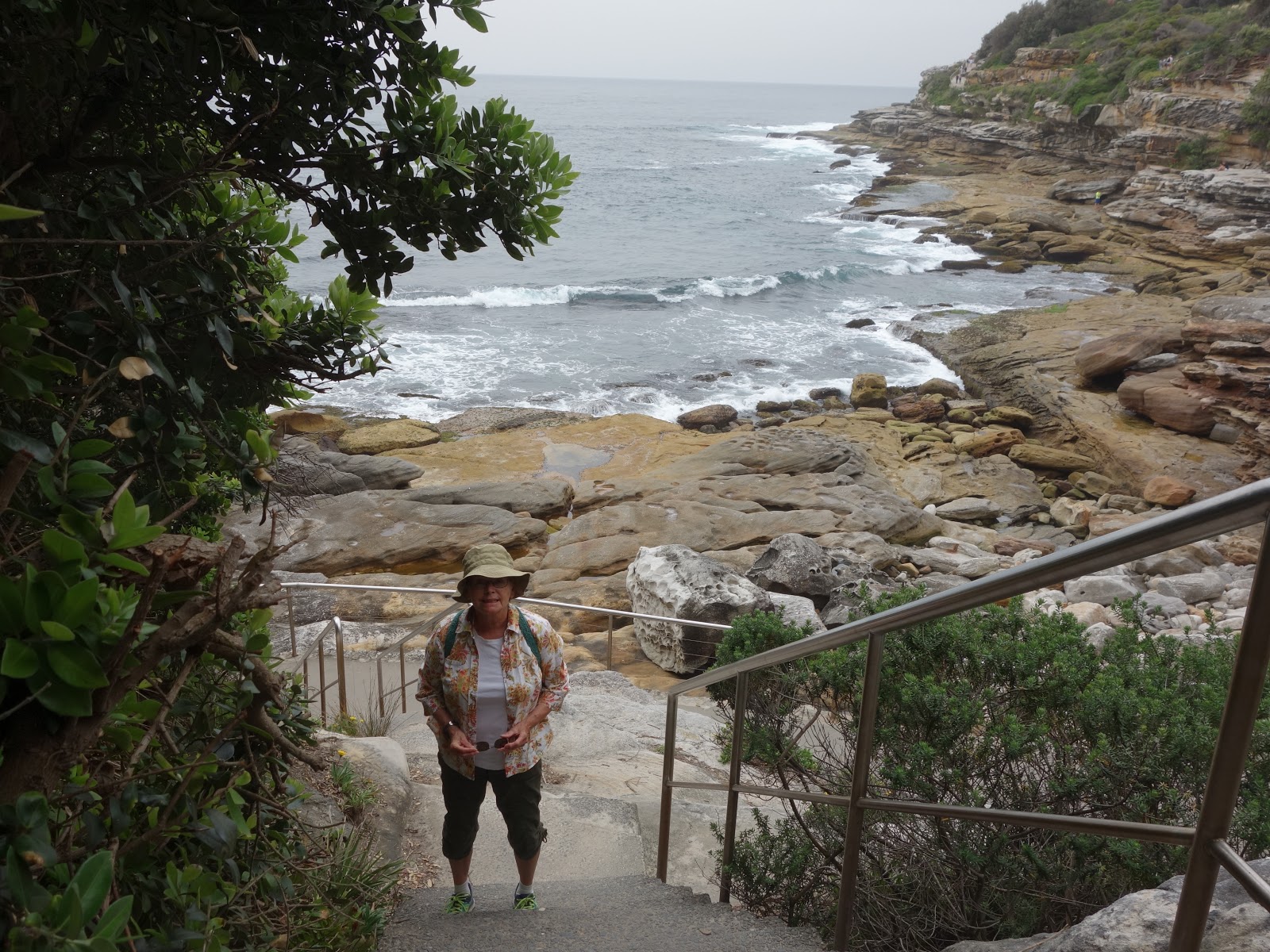
Like any good urban trek, the walk to Coogee had stairs,


multi-coloured sandstone cliffs that have been artistically eroded by wind and waves,


those same waves that sometimes crashed over the trail splashing us with cold, salty water.


When we got bored with the ocean views, we could admire the million dollars homes that are found along the trail.


Day 20- Hike #3- Blue Mountains

15 kilometres combined

The Blue Mountains are easily accessible by trains that make the trip ever hour or so from Sydney, but today we were joined and driven by our friend.


Our first hike was an up close and intimate visit to the Three Sisters.


In keeping up with our theme of urban hiking, there were lots and lots and lots


and lots of stairs that moved you intimately around the Sisters.


Tips for neophyte urban hikers. "What you go down, you must go up."


A hike into Katoomba Falls was next on the agenda.


No stairs but some tricky trails.


The attached picture was borrowed from BestSydneyWalks. The area was recovering from a long period of drought so the falls were under whelming at best. They are supposed to be quite awesome after a rainfall.


Our last stop was a short hike to view 500-1600 year old Aboriginal hand prints.  Quite impressive. They looked as if they had just been placed there yesterday.


It was the end to a glorious day!


Day 19- Hike #4- Spit Bridge to Manly Walk

10 kilometres

The trek starts at Spit Bridge wanders along the coastline across from Sydney Harbour with million dollar mansions, ancient Aboriginal sites, climbs into the dry heathlands and finishing in the cute little suburban town of Manly polished off with ferry ride back to downtown Sydney. 


After a gusty crossing of Spit Bridge, the trail turned into a narrow squeezy walk under an imposing sandstone cliff. 


For the next several kilometres we were blessed with great views of  the Pacific, million dollar architecture and tiny, intimate and uninhabited beaches that screamed out to us to get naked and go for a swim. What happens on tiny, intimate beaches stays on tiny, intimate beaches.


From the shore, we climbed up into the hills and onto the heathlands above Manly.  Here , it was dry and crispy, very different from the shoreline.


Climate change has affected the areas around Sydney much like the problems we are starting to see here in the Okanagan. Our spring weather has become dryer and hotter setting up the danger of forest fires in the heat of the summer. To reduce the danger, the Australians carry out controlled burns in the cooler months to reduce the flammable material. On this trail, one side was green while the other was  blackened and burnt. An interesting juxtaposition.


Along the way we found graffiti carved by aboriginals over a 1,000 years ago. The area is not protected from the environment so it is amazing that the carvings are still visible.


Our final destination was the holiday town of Manly, inhabited with tourists, restaurants, pubs, beaches and a ferry that would get us back to downtown Sydney in 25 minutes.


Small challenge upon our return to Sydney. The winds were high and along with a parked cruise ship with its motors running, created strong cross currents of wind and water, making it difficult for the ferry to line up on its berth giving us extra time to enjoy our last view of the harbour.


Day 21- Our last day in Sydney saw us moving to a hotel next to the train station in Sydney. We had a very early departure by train for Brisbane. A lovely dinner with our friends and early to bed.

A special thanks to Slee and Tao for their great hospitality.