Saturday, October 29, 2011

A View To Die For

Less than 5,000 people have been there and over 200 people have died trying to get there. People are still trying and dieing to get there. It is known as Qomolangmaor in Tibet, Sagarmatha in Nepal and to the rest of the world, Mount Everest, highest mountain in the world, reaching a height of 8,848 meters (29,029 ft for you Americans). Nonie and I were about to make an attempt to join that elite group of adventurers who have challenged and seen the summit.  A belated birthday present or a deranged dream. You decide.

Weather is a key factor if one wants to see the summit.  The weather on Everest can decide if you will live or die in the attempt so as the day of our summit approached, we watched it with a religious fervor.  It is the rainy season and clear days are few and far between. As the sun set on our base camp, we witnessed black, rain filled clouds piling up against Everest's west face. It did not look promising for our summit attempt the next day.
Our wake up call at 5:45 was like a high voltage current running through our bodies. Seeing the summit was not for people who like to sleep in. It can take over 20 hours to accomplish a successful summit attempt. The sun had not risen so it was difficult to see what weather we would face. Our guide tried to arrange a small breakfast for us but could find no one interested in getting up that early. Starting this adventure on a empty stomach. Good idea or bad? Only time would tell.

The night turned to false dawn as we made our way to the primary staging area.  With the light, it became apparent that those black, menacing clouds had only gotten worse through the night. This dangerous weather evoked serious discussion with our guides. "Go, no go?"  The one caveat of weather on Everest, "Don't like the weather then wait five minutes". Everest's weather can change in a instant, clouds can disappear releasing the sun. But just as quickly as the weather improves, it can  become dangerous and unforgiving.  We decided to push on and put off our decision till after we reached the final staging area.
It is here, that the waiting began. Reports coming in, indicated that the clouds were heavy and obscuring the entire summit of Everest. This type of weather situation would make our attempt to see the summit impossible so the waiting game began.  As time passed, the waiting became intolerable. There was little space to move around and we were crowded in by others, also waiting to see their moment in the sun and the summit of Everest. Anger and frustration began to show in everyone faces and voices.

The  next stage would force us to move into the "DEATH ZONE". The "DEATH ZONE" begins at approximately 8,000 metres (26,000 feet for you Americans). At this altitude there is not enough oxygen to sustain human life. Each minute you spend above this altitude without supplementary oxygen will result in deterioration of your bodily functions, loss of consciousness and, ultimately, death. We are adventurous, not crazy, we would be using bottled oxygen.
 

Just as doubt began to creep into our minds that today would not be our day, the radio crackled with the words we wanted to hear. "YOUR ARE CLEARED FOR TAKE OFF."  With those words our Beechcraft, 18 passenger light commercial plane took off for a fly by and hopefully a clear view of the much sought after Everest summit.


The twenty minute wait on the tarmac in the fully loaded plane filled with those 16 other bitching tourists had been worth it, two hours later, we were back at base camp, the 5 star Radisson Hotel in downtown Kathmandu enjoying a late breakfast with the vision of Everest's summit burned forever into our memory.
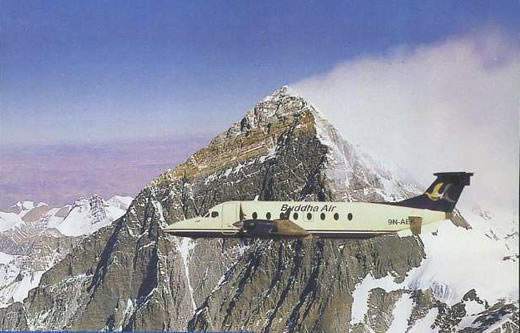


EDITOR POST SCRIPT.  Shortly after our flight, a plane carrying  16 tourists to view Mount Everest from the airport in Kathmandu, crashed while attempting to land in poor weather, killing all 19 people on board. This blog was intended to poke some fun at our flight.  It was with some trepidation that I posted this as it is in no way meant to make light of the people who died in this horrific accident.


 It does reinforce our thoughts that "life does not come with a lifetime guarantee so just do it before your warranty runs out."   


Friday, October 21, 2011

TOO, TOO MANY TEMPLES, BUT THANK HEAVEN FOR THE MONKEYS

Temples come in several flavours (flavors for you, Americans) in Nepal. The government of Nepal considers the country secular but you may get an argument from Hindu's who form 80% of the population. 11% are Buddhists and 5 percent Muslims.

Arriving back in Kathmandu, we spent a few more days visiting temples as well as many stupas, and squares with temples. The shift  from Buddhist to Hindu temples was a nice change. Many of the temples and holy sites were 500 or more years old wooden structures. I was constantly amazed by the plethora of lit candles and incense that inhabited the structures and not a fire extinguisher in sight.


Hinduism does not limit is self to one supreme deity. If one is good then many must be better. Krishna, Vishnu, Shiva, Ganesha, just to name a few of the more prominent ones.   I quit counting after 100.  Not everyone rates a temple though. 


Nonie got a little too friendly with a mother monkey.  Next thing we knew, mom brought the whole gang for a visit.


Monkeys were a fixture at many of our temple stops. This temple complex called  Swayambhunath is also known as the Monkey Temple. Some of the resident monkeys are considered holy. The back story says that they are holy because Manjushree, the bodhisattva of wisdom and learning was raising the hill which the Swayambhunath Temple stands on. He was supposed to leave his hair short but he made it grow long and head lice grew. It is said that the head lice transformed into these monkeys.


No matter where you went, the third eye of Shiva would follow you around. The third eye is the red circle seen above the eyes. Very spooky.
Meet the Living Goddess of Nepal. They (Not sure who They is?" chose  prepubescent girls on the basis of their 32 attributes of perfection, including color of eyes, shape of teeth and even voice quality. They are then are taken to meet the deities in a dark room, where terrifying tantrik rituals are performed. The real goddess is the one who stays calm and collected throughout these trials. Other Hindu-Buddhist rituals follow to finally determine the real Kumari (Goddess). We were introduced to her at her home in the Hanumandhoka Palace when our guide took us into a tiny, roofed courtyard, perhaps 30' by 30'. Our guide called out her name and surprise of surprises she came to the window and checked us out. She never leaves the palace except once a year during the Indra Jatra festival when she is visited by 1,000's worshippers. Sadly she is evicted from the cushy digs when puberty strikes and a new goddess is selected.  We were not allowed to take pictures so I have used one of her publicity pics.

The ladies were grabbing some shade after spending a long day of worship at Durban Square. A 800 year old square with many Hindu temples and even a stupa ( a mound-like structure containing relics of Buddha)  
Buses and trucks were a visual treat. Each driver personalizing his ride.
Nonie was in her happy place tenaciously bargaining for a piece of fabric. Don't see this catching on at Fabricland.
A 800 year old watering hole.
The local 7-11 franchise. These two entrepreneurs carried  a number of items much sought after by trekkers but best not to look at the Best Before dates.
Happy in his chosen profession. This smiling Hindu's sole 
(no pun intended) responsibility was to guard the shoes removed by the worshippers to the temple of  Kama. Kama was in a position (snicker, snicker) to make a lot of Hindus happy as the God of Love. 
Another contest.  How has  Kami made many Western couples happy?  E-mail your answers to us.

Tuesday, October 4, 2011

Kathmandu (Thats Pronounced Katmandoo)

As a child of the 60's, Kathmadu (pronounced katmandoo) was a mystical place where hippies dared to dream. It was the end of the "Hippie Trail" where dope was cheap, legal and no hassles' man. Today it is the poster child for the third world. Our entrance into the city from the airport was an eye opener. Far from mystical, it was teeming with people and cars, with bikes, motorcycles and scooters outnumbering the cars 50 to one. Driving through potholed and twisting lanes that veered in all directions with open ditches for storm drains and if my nose was working, sometimes sewage.


This all could have been over whelming for someone coming from the west but as we had just arrived from China, it was a slow day in Beijing for us. Our hotel was located in the old Thamel (pronounced Tamel) district of Kathmandu (pronounced Katmandoo). Once a mecca to hippies, now home to trekking outfitters, souvenir shops, sketchy hotels and hostels. It is populated with tourists, hikers, trekkers and really old ex-pat hippies. These old hippies could be spotted miles away, with their long, grey and thinning hair worn in scraggly pony tails, wearing tie dyed tee shirts and enough musk oil to keep mosquitoes at bay. Living up to its past, we were often approached by locals whispering "Do you want to buy some ?". The purchase was always left unsaid and if they weren't selling ? then they were selling Tiger Balm, the cure-all for everything including flatulence, if you can believe everything the label says. Rub it on and watch it work. We did however manage to find several healthy crops of ? along the way which would have allowed us to cut out the middle man.   

Only one evening to enjoy the ambiance as we left the next day for a two night, three day trek into the wilder, yet tamer parts of Nepal. It was the rainy season and a ten day trek to Everest sleeping in tents along the way, was not gonna happen so a two day hike with a warm hotel rooms at the end of the day seemed like a good compromise.

So with our guide Raj, we drove about three hours outside Kathmandu (pronounced Katmandoo) to a temple who's name eludes me.  Way too many temples on this trip. This was to be the start of our hike. The road to the temple was little more than a mud track and we spent more time walking than riding so the under carriage of the car could clear the muddy tracks that made up the road.

For the next three days we were treated to some wonderful as well as exciting moments  On our second day, we had been traveling on a trail for about 2 hours when we found the trail had disappeared in a landslide of about 150 metres.  We had two choices, back track 2 hours and find another route or make our way across the washout to the trail on the other side. This involved a traverse along a steep side hill with only small foot print steps made by the  idiots who came before us to cross over on. In some cases we had to dig out our own steps to make it across as the gap between their steps was too far apart for a safe move.  The ground was wet and slick and there was a small river rushing about 300 metres below us. Needless to say we were scared $hi+le$$ for the entire crossing and arrived to the other side breathless and our knees knocking. Death by laziness is a stupid way to go.


Luck was with us for most of the hike as we were spared having to deal with any torrential downpours. They only came at night when we were safely stowed in our hotels sipping the local beer. Our days were mostly dry or at most. marred by a light drizzle.

Lots of mud though along with some very nice and not so nice bridges.  Nonie was a trooper and attacked each bridge with gusto and false bravado, singing her happy song as she wended her way slowly across to the other side.

Three days later we arrived at a small village where we were picked up and transported back to Kathmandu (pronounced Katmandoo).  Along with the beautiful memories, I will also carry the scar from a slug who made a pig of himself sucking the little blood I have left. He some how found his way up onto my ankle under my pants and used me as a buffet till bloated, he dropped off somewhere along the way. Ahh, good times.

Tuesday, September 13, 2011

Stoned Forest, Far Out Man


Sorry, another 60's flashback. That would be the Stone Forest.  


When informing some of our more China savvy colleagues about China's sudden decision to close Tibet and the addition of Yunnan to our travel itinerary to fill that void, we were informed that Yunnan was the home of China's cannabis industry. So Stoned Forest seemed like  the logical place to go and explore. The forest is the "#1, must go to" place if you are visiting Kunming.


As reported by the International Hemp Association of Amsterdam, Netherlands, "Yunnan Province, in the southwest of the People's Republic of China, bordering Myanmar (Burma), Laos and Vietnam, is home to many of China's minority nationalities. Although the Han majority have largely given up hemp usage in daily life, several of Yunnan's minority ethnic groups continue to use hemp for both fiber and food. However, there is very little consumption of Cannabis products for recreational purposes by either resident Chinese or visitors.Despite these facts, the Yunnan provincial government has instigated policies that confuse drug Cannabis ("marijuana") with industrial hemp. Since the spring of 1998, the growing of Cannabis for any reason has been prohibited, although Cannabis still flourishes in most parts of Yunnan. Confusion continues." 
 
What we found at the Stone Forest was a beautiful park filled with the coolest limestone karst formations that we will remember for the rest or our lives and the munchies. Did I mention the munchies? Maybe flashbacks again, but I couldn't stop thinking of food while we spent hours wandering, climbing and admiring Mother Nature's own creations. One karst looked like a ice cream cone, another a carrot while several looked like medium rare t-bone steaks smothered in mushrooms and fried onions, with a baked potato and vegetable de jour on the side.  Did I mention we had the munchies?

Our next stop was Dragon Gate, a Buddhist site that clings to the side of a 2,000 foot cliff. Built in 1781, it has successfully withstood wind, rain and the odd earthquake. Anyone with acrophobia, claustrophobia, bathmophobia, cremnophobia, iconophobia, seismophobia, agoraphobia and sinophobia should think twice before visiting this very high (not to be confused with "a high") scenic spot.


Our trip to Dragon Gate involved a 10 minute chairlift ride to the start of the 700 feet climb on skinny little trails, carved out of the cliff. Along the way, were areas to stop and commune with your god or Buddha or just to enjoy the view of Kunming and Dian Lake. If a trail wasn't possible then a tunnel was cut through the cliff.  At the top, was a cool and quiet grotto which we did not see as the lines were too long. There were lots of tourists that day. We made the mistake of sitting down at one of the benches carved out of the cliff. As we sat, we were approached by a young Chinese girl asking to have our picture taken with her. Within a minute we had a lineup of Chinese families wanting to take a picture with us. We had to cut them off after 20 minutes as we still had one more stop before our day was over.


Our last stop was a seudo minority village containing examples of the village housing and living conditions of the 25 minorities currently listed in Yunan. We were outta there in under 30 minutes. Nuff said.

This is our last stop before we leave China for the second time and we are safe to say, not the last time.


Saturday, September 3, 2011

Shangri La Since 2001


Shangri La, a mythical place first described in the novel Lost Horizons. To quote Wikipedia, Shangri La is " a mystical, harmonious valley, gently guided from a lamasery". Our Shangri La is formally known as "The Shangri La Ecological Tourism Zone" and was created and renamed Shangri La in 2002 by the central government in hopes of spurring tourism to the area. It seems this clever marketing ploy has worked as Chinese tourism has increased a bazillion times since 2002. Even a few foreigners (wink, wink, nudge, nudge) are attracted. It does sort of meet the qualifications as it is located in a "mystical valley". (Their words, not mine)


It has the requisite lamasery. The Gedan Songzanlin Monastery (Guihua Monastery) is a centuries old monastery located on the outskirts of town. An operating Tibetan monastery, it has been basically rebuilt in the last two decades although the knickknacks have been around for four or five hundred years. They estimate about 700 monks live on the premises. It is claimed that at one time there were over 3,000 monks living in residence. If it is any consolation , at least the monks living accommodations look to be around 300 or 400 years old. The monks were very busy marketing Buddha the day of our visit, with visitors streaming through the place buying charms, prayer beads, images, incense as well as filling the donation boxes. Buddhism seems to be a growth industry in Shangri La. But with a name like that, how can it not do well?


Meet some of the harmonious inhabitants of Shangri La. These folks are Tibetan but there are over 25 ethnic minorities in Yunnan. To qualify as an ethnic minority, there must be at least 50,000 people registered and claiming that particular ethnicity. The big five are the Bai, Dai, Yi, Hani, Tibetan, and Naxi minorities, all with populations in the millions. There are no real perks being a minority other than you can ignore the one child rule so it not uncommon to see large family units. Not sure if this can be called a perk. It is said that there are dozens more minorities around but they are not formally registered as their numbers do not qualify them to be a minority. Its funny but I thought that it would be inherent based on the definition of minority. What do I know? We will be visiting a model minority village in Kunming where they have recreated typical examples of how each of the 25 minorities (registered) live. Keep you posted on that visit.


The valley is also home to a large national park with two large and pristine glacier fed lakes. There are over 8 kilometres of wooden walkways that allow you access to the park and the lakes or you could opt to take a bus from scenic spot to scenic spot, saving you all that legwork. You can see in the picture what most of the tourists chose to do. Even our guide, frowned when we opted for the walk but Nonie just kept herding her along ignoring her grumbling. Poor girl didn't know what hit her. No buses for the Cornell's.


Saw two more minority groups as we left the park. The one on the left looks especially tasty as I would kill for a big juicy medium rare steak right now.


Next stop Kunming, the last stop on our Chinese adventure.


Tuesday, August 16, 2011

Are We There Yet.


Today is a travel day with a number of stops along the way before the promised Shangri La . All the stops involve the Yangste, Yangze, Chang Jiang, all names for the longest river in Asia, third largest river in the world. With a length of over 6,400 kilometres, it begins its life as run off from glaciers of the Tibetan Plateau before exiting 6,400 kilometres later into the East China Sea near Shanghai.


Our first stop is the first bend in the Yangste. As with all Chinese tourists sites, a back story is included with the view. It seems that three sister rivers (Nu River, Lancang River, Jinsha River) met here and had a disagreement. The Nu and Lancang Rivers decided to go south while their sister Jinsha River decided to seek her love and fame going to the east. This persistent (their words, not mine) little river transformed itself into the first bend of the Yangtse. Basically, a million years ago the river went left instead of right. Right would have seen it flow through Vietnam or Laos before exiting into the ocean. Going left, it became the mighty Yangste River.


The Yangste is home to over 1/3 of China's 1,300,000,000 people and provides water, food, electricity, transportation and sadly sanitary disposal to all.


Our final stop of the day was the Leaping Tiger Gorge. Here the river narrows to less than 25 metres. (79 feet for you Americans) The gorge is a must see for Chinese tourists and it was a busy place that day. For those of you BC readers, think Hells Gate. It is not a place for the mobility impaired as it involved going down then back up about 500 steps. Though if you didn't feel like walking back up, you could rent a sedan chair and two burly porters to carry you back up the 500 steps. Pretty impressive to watch these guys in action.


And of course, there is a back story. Legend has it that a tiger was being hunted and he leaped to safety by first leaping to a rock (see background of picture) located in the middle of the gorge before leaping to the opposite bank. Hence the name, Leaping Tiger Gorge. Very impressive as well as noisy, watching all the water roar through that little gap. The stairs were a nice workout but I must admit to being tempted to ride back up to the top in a sedan chair. Costs was 100 RMB or about 13 bucks. OOOH, so tempting but too embarrassing to consider. . Shangri La here we come.

Saturday, August 13, 2011

Snowy Mountains and Yak Pooh

Billed as a trip to see Jade Dragon Snow Mountain, a snow capped mountain and the southern most glacier in the northern hemisphere. A 90 minute bus ride that was a thrill in it self, then a transfer to a chair lift for a 20 minute ride. Sadly, the heavy cloud cover did not make it promising that we would see anything.


Arriving at the top we were pleasantly surprised to find a small Tibetan monastery that was not mentioned in the itinerary. We are deep into the TAR, the Tibet Autonomous Region so it should not have been a surprise. They like to locate the temples as high as possible to be closer to heaven. It was a slow climb up to the monastery only to find it guarded by a very surly Tibetan chicken.


Saved by a friendly monk, we were given a personal tour of the monastery. Not sure of his language but it was definitely not Chinese. He kept up an on going monologue on all the monastery's features. Tibetan monasteries are always covered in prayer flags. The flags are never removed except by nature (wind, rain) and can be often found littering the landscape.


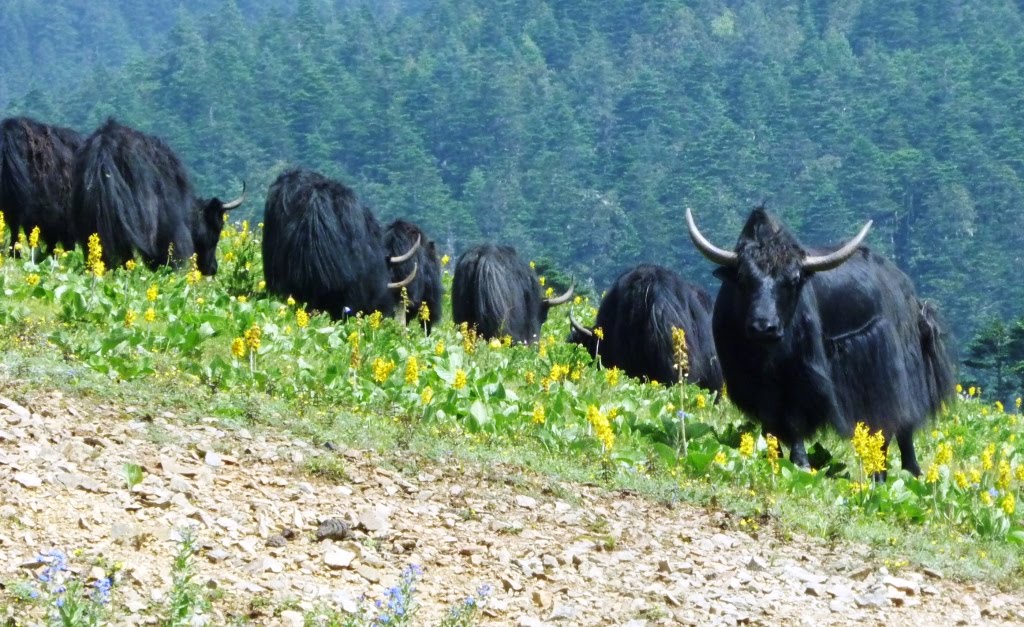
Saw our very first Yaks. The monastery had quite a herd. The candles in the monastery are made with yak butter. To be honest, not sure if I would ever consider trying to milk one of these brutes.


At around around 4000 metres, we were not moving or thinking as fast as we should have due to the low oxygen content. Had to be constantly vigilant to avoid stepping in Yak pooh.

Heading back to the Yangste River and onwards to Shangri La tomorrow.