Wednesday, October 4, 2017

The Big Bang Theory Visited


It was at 8:15 AM on August 6th, 1945, when the Enola Gay released the first atomic bomb over the City of Hiroshima. 


As the bomb reached an altitude of 2,000 feet, it exploded. The explosion virtually destroying all of Hiroshima, killing an estimated 70,000 people immediately. 


70,000 more would die in the following weeks due to radiation poisoning. More would succumb over the next five years because of  cancers and other illnesses due to exposure of high levels of radiation released from the explosion. 


72 years later, Hiroshima is a bustling city of 1.2 million people with very few reminders of the devastation left behind by the first use of a nuclear weapon. 


The Peace Memorial park, also known by the iconic Genbaku Dome (A-Bomb Dome) holds the skeletal remains of the Prefectural Industrial Promotion Hall. 


The hall sat approximately 150 metres from the centre of the blast. It has been designated a UNESCO World Heritage Site in /1996.  


The dome stands almost exactly as it did after the bombing. Bricks, stones and other debris laying exactly where it landed on August 6, 1945.  Only minimal changes have been made to ensure the stability and safety of the structure.


The location of Hiroshima Peace Memorial Park was once the city’s busiest downtown commercial and residential district but destroyed by the nuclear explosion. Today there are memorials, monuments, museums, and lecture halls, which draw over a million visitors annually.


The day we visited, the park was celebrating the Hiroshima Flower Festival. The festival included many entertainment stages with varieties of entertainment. Our favourite were the Taiko drummers. You have got to be in good shape to be a Taiko drummer.


The park was jam packed with a 2 hour wait to get into the Hiroshima Peace Memorial Museum, dedicated to documenting the atomic bombing of Hiroshima for future generations. The crowds were large and the  line was long but the Japanese were up to the task making sure that everyone knew where the end of the line was.


In November of last year, we paid a visit to the Smithsonian Air and Space Museum located near Dulles Airport outside Washington DC. I took a photo of the Enola Gay, knowing that we would be visiting Hiroshima 5 months later.  While looking at the plane made me a bit queasy,  standing in front of the Genbaku Dome, left me queasy and speechless.


In 1945 a Gallup poll was immediately taken after the bombing which found that 85% of Americans approved of using this new atomic weapon on Japanese Cities. Pearl Harbour was still on their minds. In 1991, a Detroit Free Press survey conducted in both Japan and the US found that 63% of Americans thought the actions were a justified means to end the war while only 29%  thought the action was unjustified. In Japan, 29% thought the bombing was justified while 64% thought it unwarranted. In 2015, a Pew Research Centre Survey found that now only 56% thought the bombing was justified while 34% saying it was not. In Japan, only 14% said the bombing was justified and 79% who said it was not. What would the Americans and Japanese say now with North Korea and a vitriolic Trump, fresh in their minds.

Can there be any justification for the use of nuclear weapons.

I think not.

It was a late train back to Kobe.  We had lots to think about.
Tomorrow, we head to Tokyo.

Tuesday, October 3, 2017

Another Day, Another Ferry


It was going to be a long but hopefully an exciting day. I was about to tick off one more box on my bucket list. Ride the Bullet Train or Shinkasen as it is known in Japan. These trains can reach speeds up to 320 kilometres per hour. and run on a network of rails linking most major cities on the islands of Honshu, Kyushu and Hokkaido.
We were off to Hiroshima as well as the small island of Miyajima, a distance of just over 300 kilometres from Kobe. Travel time is a short 90 minutes. One small glitch. Bullet trains do not pass through Kobe so we had to take slower commuter train to  another station which added 15 minutes to the trip. Arriving, we discovered the commuter station was not the Shinkasen station but thanks to two young Japanese men dressed like pilots,  who led us to the Shinkasen station. We assumed they were pilots/engineers for one of the Shinkasen trains.


We arrived early and were rewarded with cups  of Seattle's Best before catching the Bullet. We had been making do with instant coffee in our hotel as the local Starbucks in Kobe was never open before we left on our daily adventures. I had to hike down three stories to a large potable hot water dispenser, fill two cups with hot water and return to the room without spilling. A pretty glorious feat, first thing in the morning for a 65 year old.


The train lived up to it's reputation. Clean and fast. Arriving on time to Hiroshima Station where we boarded a local train that would take us to the ferry for Miyajima Island. Yes, another ferry.


Thankfully a short, 10 minute trip. Not long enough for Nonie to start to panic.  It was very full however which had her counting life jackets and planning escape routes.


The national holiday had started and Japanese tourists were out in hordes. Anticipating a long wait to board, we were disappointed when the crew fully emptied and loaded the ferry in under 5 minutes. The Japanese know how to deal with hordes.


Miyajima also known as Isukushima is a small island in Hiroshima Bay about 30 minutes outside Hiroshima. It is known for its forests and ancient temples and is one of the top three scenic spots of Japan. 


The giant, orange Grand Torii Gate partially submerged at high tide marks the entrance to the Itsukushima Shrine. We arrived at low tide and were able to walk out to the gate. 


There was a 90 minute wait to get into the Shrine so we opted to view it from the tidal flats


and avoid the hordes.


Next, we hiked up to the Daisho-in Temple located about 1/2 way up Mount Misen.


The temple is one of the most important temples of Shingon Buddhism, one of the major schools of Buddhism. As we discovered, Buddha comes in many shapes 


and sizes. 


The Island is home to a herd of about 1200 Sika Deer. At one point, they were worshipped by the locals. After WWII, the deer were struggling to survive, so the islanders offered them food. Over time they became citified and a major tourist attraction. Tourists by the thousands would come to the island to feed the tame deer with rice crackers sold by local vendors.


The now, well fed deer flourished, causing a huge surge in their numbers. This led to deer poop everywhere, vehicular / deer interactions and  deer fences due to depletion of the wild and planted vegetation found on the island. In 2008, the city put up "Do Not Feed the Deer" signs, hoping that as the deer got hungry, the would move out and return to wild.


Not so, the signs are ignored by many and the ravenous deer will eat anything. Maps, brochures, plastic bags.  Don't leave your picnic basket unguarded.


Time to head to Hiroshima.


Saturday, September 30, 2017

Another Day, Another Palace


Day 12, once again found us at the train station.


Today we are off to Kyoto and a visit to the Imperial Palace. The Kyoto Imperial Palace is the former ruling palace of the Emperor of Japan till 1869 when they moved to Tokyo. It has been around in some form or other since the 12th century. 


For state ceremonies, the dignitaries would enter through the Kenreimon Gate  which has a cypress-wood roof, and is supported by four unpainted wooden pillars. This gate would have been used on the rare occasions of the emperor welcoming a foreign diplomat or dignitary, as well as for many other important state ceremonies.


Passing through the Kenreimon, the inner gate Jomeimon would appear, which is painted in vermilion and roofed in tile.


This leads to the Shishin-den which is the Hall for State Ceremonies. Gates are every where, all having some special purpose.  


And of course what is a palace with out a garden.


We were not disappointed. 


One last stop before heading back to Kobe. 


Kinkaku-ju, literally "Temple of the Golden Pavilion"), officially named Rokuon, literally "Deer Garden Temple", is a Zen Buddhist Temple in Kyoto.


One of the most popular and most photographed sights in Japan. 


A beautiful bronzed Phoenix adorns the peak of the roof. 


The temple is now used to house Buddhist relics but a simpler more utilitarian temple was located nearby if you needed to get your Zen on.  


Friday, September 29, 2017

Had a Beef in Kobe


Day 10 dawned sunny and early for us as we were to arrive in Kobe around 9 am and we wanted to ensure we had the time to enjoy our delicious breakfast, instant coffee and to view the Akashi Kaikyo Bridge as we entered the port of Kobe.


The Akashi Kaikyō Bridge is a suspension bridge, which links the city of Kobe on the Japanese mainland of Honshu to Iwaya on Awaji Island. It crosses the busy Akashi Strait on the Inland Sea.  It has the longest central span of any suspension bridge in the world, at 1,991 metres (6,532 ft).  


Right on time, we docked at the port of Kobe Sannomiya Ferry Terminal.  Nonie was all smiles. From the terminal we were to catch a commuter train that would take us in to Kobe Sannomiya Train Station and our hotel located only a few blocks away. 


As we walked off the ferry we were followed by the English couple who had joined us on the ferry in Shanghai. We did not see much of them on the ferry.  They followed us to the small urban train station located next to the terminal. We started to talk and discovered that they were also joining us on the cruise to Vancouver. Their journey was almost a mirror image of ours.  Fly to Shanghai from England, catch the ferry to Japan, spend a few days in Kobe, travel to Tokyo for a few days before catching the cruise to Vancouver. We separated at the train station where they to were staying at an Air b & b only a few blocks from the hotel. 


Tonight, my plan was to find a Kobe Beef restaurant and tuck into one. It is the Holy Grail of meat.


Wagyu” refers to any cattle that is bred in Japan or the Japanese-style. Kobe beef is comprised of a very particular strain of Wagyu called Tajima-Gyu that is raised to strict standards in the prefecture of Hyogo. Hyogo's capital city is Kobe, thus the name “Kobe Beef”. A major factor in the quality of Kobe steaks is the uncompromising regulations the region uses for its cattle. 
To be labelled Kobe, cattle must meet the following seven standards upon slaughter. Bullock (steer) or virgin cow.  Tajima-Gyu born within Hyogo Prefecture. Fed on a farm within Hyogo Prefecture. Meat processed within Hyogo Prefecture. Marbling rating (BMS) of 6 or higher on a 12-point scale. Meat quality rating of 4 or higher on a 5-point scale. An overall weight not exceeding 470 kg. 

Because of these stringent standards, only 3,000 head of cattle qualify as authentic Kobe cattle each year. In Kobe, the Mitsukoshi department store sells 870 grams for 31,500 Yen ($343 CDN a pound).  Translate that into a 16,000 Yen ($177 CDN) for a 250-gram steak in a restaurant.  No virgin beef for us, so it was Wagu and even that set us back 7,500 Yen ($83 CDN)


Kobe Beef is not readily available outside of Japan but you can buy true Wagyu Beef in Costco for $109.00 USD per pound but must buy a minimum of 11 pounds. I believe that that  having eaten beef in Kobe I can look you in the eye and say with a straight face that I have eaten Kobe Beef. 


Day 11, and we were off to the city of Himeji, about an 60 minute train ride from Kobe. This was our first time traveling on the much vaunted Japanese train system. It lived up to it's reputation. 


Himeji is home to the White Crane Palace also known as Himeji Castle is the largest and most visited castle in Japan, and was one of the first UNESCO World Heritage Sites in the country. It has been around in some form or other since 1333. 


The Castle/Palace sits on a small hill overlooking Himeji.


We arrive early as we hoped to avoid the large crowds that were expected. We were visiting Japan in the middle of a 3 day national holiday and were warned that things could get busy. The Castle/Palace is entirely constructed with wood. To tour, you must be ready to climb up six stories on steep wooden stairs.   


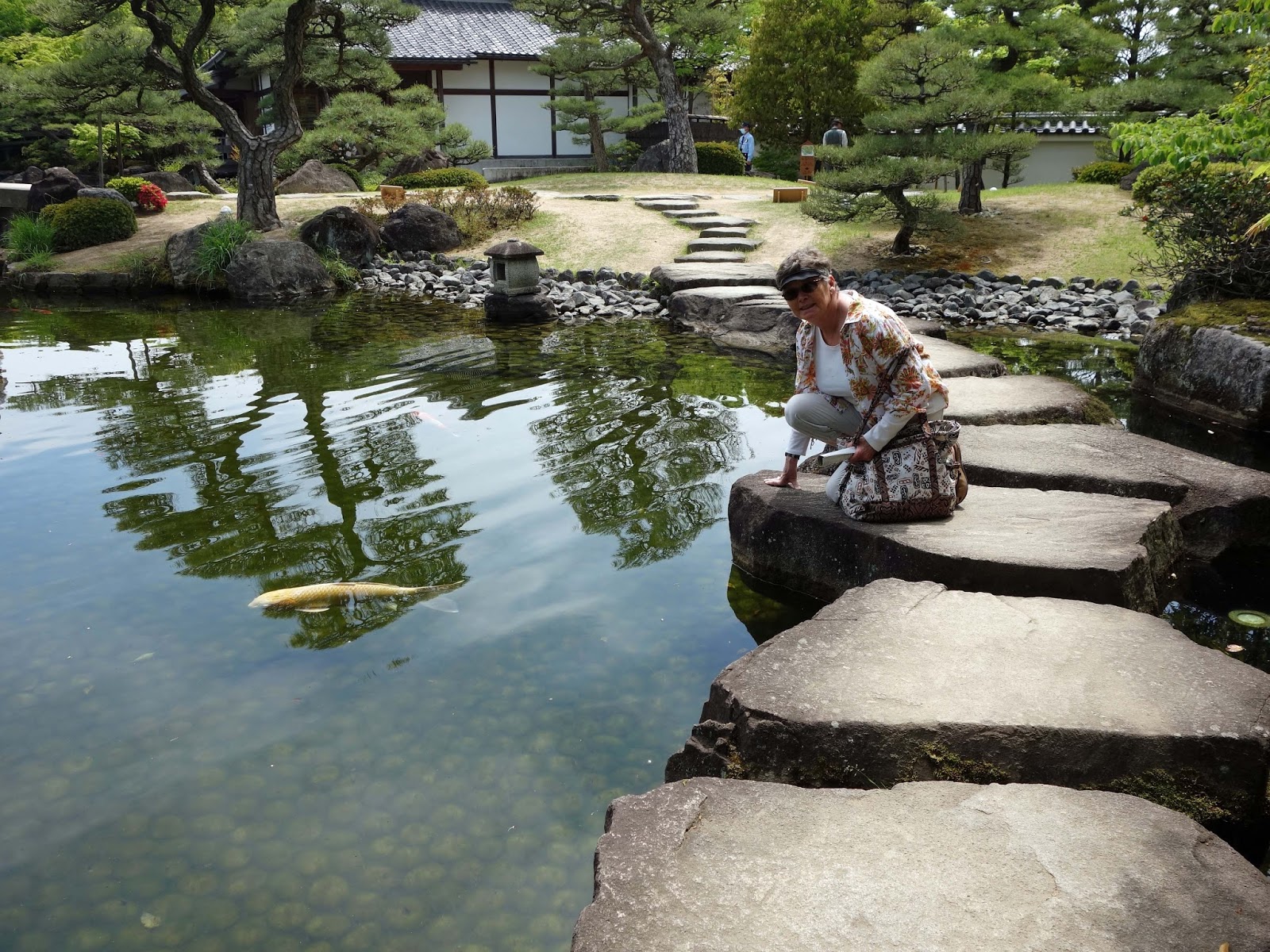
From there we headed out to what would be our first of many Japanese parks.  Japanese parks are not like North American parks that are filled with huge grassy areas, large walkways and big shady trees.


They are smaller, more intimate filled with quiet little areas, each unique in their own way.


The trees are small and delicately manicured.


Quite often water plays a central theme in each area. Ponds, creeks, and rivulets abound. Many filled with multi-coloured Koi and Carp.


Despite the crowds, Japanese gardens are spookily quiet, almost church like. No noisy games of Frisbee or bocce here, just a time to commune with nature.


Every park has a tea house where enjoying a cuppa is not so simple and demands a ceremony before, during and after. Tea is a very serious business in Japan


Our first full day in Japan was wonderful. If we were struck by any one thought, it was how clean and efficient life is here.  Tomorrow, we are off to Kyoto and the Imperial Palace.